WorldLens | Education & Technology
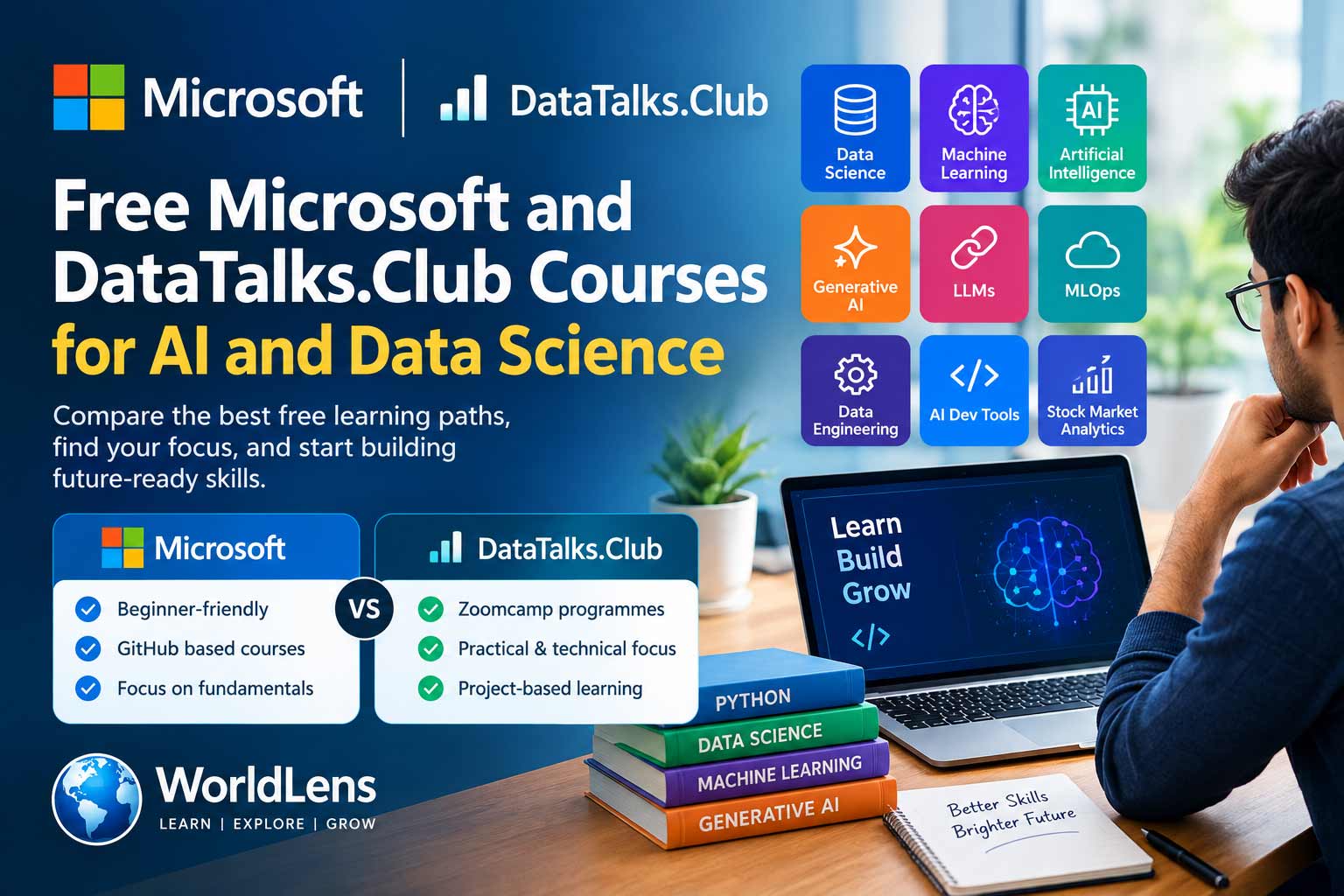
Learners looking to build skills in artificial intelligence, machine learning and data science can find several free learning resources from Microsoft and DataTalks.Club.
Microsoft provides a collection of beginner-oriented courses through GitHub, covering areas such as data science, machine learning, artificial intelligence and generative AI. DataTalks.Club offers a series of Zoomcamp programmes focused more heavily on practical data and machine-learning engineering.
The two learning paths cover different areas and can be explored according to a learner’s existing skills and learning objectives.
Microsoft’s Free AI and Data Science Courses
Microsoft’s GitHub-based learning resources include courses covering foundational concepts as well as practical exercises.
1. Data Science for Beginners
This course introduces fundamental concepts used in data science, including:
- Data handling
- Statistics
- Data analysis
- Data visualisation
- Data preparation
- Basic data science concepts
- Responsible and ethical considerations
It is designed as an entry point for learners who want to understand how data is collected, processed and analysed.
2. Machine Learning for Beginners
The machine learning course introduces commonly used machine-learning concepts and techniques.
Topics include:
- Regression
- Classification
- Clustering
- Model evaluation
- Python
- Scikit-learn
- Natural language processing
- Time-series concepts
The course provides learners with an introduction to creating and evaluating machine-learning models.
3. AI for Beginners
This course introduces several areas of artificial intelligence and deep learning.
Its topics include:
- Neural networks
- Computer vision
- Natural language processing
- Deep learning
- Reinforcement learning
- AI ethics
- TensorFlow
- PyTorch
The course provides broader exposure to different AI concepts and technologies.
4. Generative AI for Beginners
Generative AI has become an important area of modern AI development. Microsoft’s beginner-focused course introduces concepts related to building and working with generative AI applications.
Topics include:
- Generative AI fundamentals
- Prompt engineering
- Working with AI models
- Application development
- Responsible AI practices
DataTalks.Club Zoomcamp Programmes
DataTalks.Club provides several Zoomcamp programmes covering data engineering, machine learning and modern AI development.
1. Machine Learning Zoomcamp
The Machine Learning Zoomcamp focuses on practical machine-learning workflows.
Topics include:
- Machine-learning model development
- Model training
- Evaluation
- Model deployment
- Machine-learning engineering
The course is oriented toward understanding the process of taking machine-learning models from development toward deployment.
2. Data Engineering Zoomcamp
This programme focuses on the infrastructure and workflows used for data engineering.
Topics include:
- Data pipelines
- Data warehouses
- Data processing
- Workflow orchestration
- Analytics infrastructure
It can be useful for learners interested in understanding how data systems are built and managed.
3. MLOps Zoomcamp
MLOps combines machine learning with software engineering and operational practices.
The programme covers areas such as:
- Model deployment
- Monitoring
- Automation
- Machine-learning operations
- Production workflows
4. LLM Zoomcamp
The LLM Zoomcamp focuses on applications based on large language models.
Topics include:
- Large language models
- Retrieval-augmented generation (RAG)
- AI application development
- LLM-based systems
- AI agents
5. AI Dev Tools Zoomcamp
This programme focuses on using modern AI tools in software development workflows.
Topics include:
- AI coding assistants
- Chatbots
- IDE integrations
- AI development tools
- AI agents
Basic programming knowledge is useful for following the material.
6. Stock Market Analytics Zoomcamp
This programme applies programming and data-analysis techniques to financial-market datasets.
Topics can include:
- Python
- Data analysis
- Data visualisation
- Market data
- Analytics workflows
The focus is on using technical and analytical tools to work with stock-market-related data.
Microsoft vs DataTalks.Club: Course Structure
The two learning paths have different approaches.
| Area | Microsoft Courses | DataTalks.Club Zoomcamps |
|---|---|---|
| Main focus | Fundamentals and concepts | Practical engineering and applications |
| Data Science | ✓ | Selected programmes |
| Machine Learning | ✓ | ✓ |
| Data Engineering | Limited focus | ✓ |
| MLOps | Limited focus | ✓ |
| Generative AI | ✓ | ✓ |
| LLMs | Introductory coverage | Dedicated programme |
| AI Development Tools | Introductory coverage | Dedicated programme |
| AI Agents | Covered in relevant material | Covered in relevant programmes |
| Learning format | GitHub-based lessons and exercises | Zoomcamp-based programmes and projects |
| Suitable starting point | Beginners | Learners with basic technical knowledge |
Which Path Covers What?
The choice depends largely on the learner’s starting point and intended area of study.
Someone beginning with little or no experience in data science may start with Microsoft’s introductory material covering data, statistics, machine learning and AI concepts.
Learners who already have basic programming, Python, SQL or command-line knowledge may explore DataTalks.Club’s more engineering-oriented programmes.
For learners specifically interested in modern AI application development, the relevant topics include generative AI, LLMs, RAG, AI agents and AI development tools.
How to Start Microsoft’s Courses
Microsoft’s learning repositories can be accessed through GitHub.
Step 1: Create a GitHub Account
Create or use an existing free GitHub account.
Step 2: Find the Course Repository
Search Microsoft’s official GitHub repositories for the relevant course, such as Data Science, Machine Learning, AI or Generative AI.
Step 3: Start Learning
Courses can be followed through the repository materials. Depending on the course and learner’s setup, the exercises can be completed using browser-based development environments or a local computer.
How to Join a DataTalks.Club Zoomcamp
The process is slightly different for Zoomcamp programmes.
Step 1: Select a Programme
Choose a programme based on your area of interest, such as machine learning, data engineering, MLOps or LLM applications.
Step 2: Check the Course Information
Review the relevant GitHub repository and course information for the current schedule, registration details and prerequisites.
Step 3: Register
Follow the registration process provided for the selected programme.
Step 4: Review the Prerequisites
Some programmes expect familiarity with areas such as:
- Python
- SQL
- Git
- Command-line tools
- Basic programming
The requirements can vary between programmes.
Building a Learning Path
A learner can also combine resources from both platforms rather than following only one programme.
A possible progression could be:
Data fundamentals → Python → Statistics → Machine Learning → Deep Learning → Generative AI → LLMs → RAG → AI Agents → Deployment and MLOps
The exact order can be adjusted according to the learner’s previous experience and career objectives.
Final Takeaway
Microsoft’s GitHub courses and DataTalks.Club’s Zoomcamp programmes cover different parts of the AI and data ecosystem.
Microsoft’s material provides a broad introduction to data science, machine learning, AI and generative AI. DataTalks.Club provides programmes focused on areas such as machine-learning engineering, data engineering, MLOps, LLM applications, AI development tools and analytics.
For learners, the practical approach is to first identify the skills they want to develop and then select courses that match their current level and objectives.
WorldLens will continue to cover learning resources, technology, artificial intelligence, data science and emerging digital tools for readers interested in building practical technology skills.