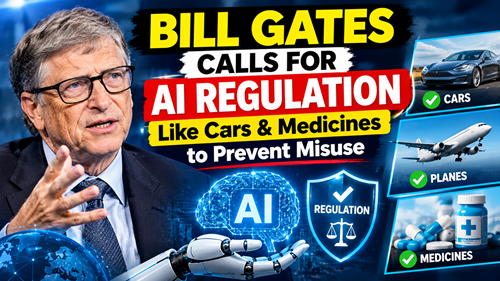
Microsoft co-founder Bill Gates has called for stronger regulations on artificial intelligence (AI), arguing that the technology should be subject to safety standards similar to those applied to cars, aircraft and medicines. He believes that appropriate safeguards could help reduce the risks associated with AI while allowing society to benefit from its growing capabilities.
In a statement shared on X, Gates highlighted the importance of establishing rules that balance technological progress with public safety. He acknowledged that regulation alone cannot eliminate every potential danger, but argued that it could make it harder for malicious individuals to misuse powerful AI systems.
Gates also stressed that governments, technology companies and other stakeholders need to give AI safety greater attention. In his view, the current approach to regulating artificial intelligence still requires significant improvement.
Bill Gates Says AI Regulation Needs More Attention
As AI tools become increasingly advanced, concerns about their potential misuse are growing. These include the spread of misinformation, cybercrime, privacy violations and the possibility that increasingly capable systems could be used for harmful purposes.
Gates believes that lessons from other regulated industries can help policymakers develop a practical framework for AI safety. Aviation, automobiles and pharmaceutical products operate under established safety requirements designed to reduce risks to the public.
He has argued that AI deserves comparable attention because of its broad reach and potentially serious consequences.
However, Gates has also cautioned against treating every worst-case prediction about artificial intelligence as inevitable. He supports a balanced approach that addresses credible risks without unnecessarily restricting beneficial innovation.
Bill Gates Says Some AI Doomsday Predictions May Be Exaggerated
While advocating stronger safeguards, Gates has questioned some extreme predictions about AI potentially causing human extinction.
In an interview with CNN, he suggested that discussions about the possibility of AI threatening all humanity can sometimes go too far. He believes that the debate should distinguish between realistic dangers and highly speculative scenarios.
At the same time, Gates has previously warned that powerful AI systems could contribute to catastrophic events if they are developed or used irresponsibly.
His position reflects two concerns: the need to take serious AI risks into account and the importance of avoiding exaggerated claims that could distract from more immediate challenges.
Gates has also argued that AI may present risks beyond those associated with conventional technologies, making effective oversight particularly important.
Microsoft President Brad Smith Says AI Has Fewer Safety Rules Than Everyday Products
Microsoft President Brad Smith has also called for stronger AI oversight, comparing the technology’s regulatory environment with the rules governing ordinary consumer products.
Smith has pointed out that products such as washing machines and milk are subject to safety requirements and inspections, while AI systems do not yet face an equally consistent framework across all jurisdictions.
He has described artificial intelligence as a technology that can serve beneficial purposes but can also be turned into a weapon when misused.
According to Smith, governments should begin developing effective safeguards rather than delaying action until the technology becomes even more powerful.
His comments add to a wider discussion about how policymakers can establish standards for AI development, deployment and accountability.
Satya Nadella Warns Against Blindly Trusting AI Models
Microsoft CEO Satya Nadella has also highlighted the importance of security when deploying increasingly capable AI models.
Nadella has argued that organisations should not automatically assume AI systems are completely trustworthy, particularly when those systems have access to sensitive information, digital tools or business data.
He has advocated a cautious approach in which potential security failures are anticipated and appropriate containment measures are established from the beginning.
This approach is intended to limit the damage that could occur if an AI model is compromised or behaves in an unexpected way.
As AI becomes more deeply integrated into workplaces and digital services, security controls and human oversight are likely to remain important parts of responsible implementation.
AI Regulation Debate Divides Technology Companies
The discussion over AI regulation has become a major issue for technology companies and governments around the world.
Some industry leaders support stronger safeguards to address security threats, misuse and the possibility of advanced AI systems operating beyond intended limits. Others warn that excessive regulation could slow innovation, increase compliance costs and weaken the competitive position of companies operating in countries with stricter rules.
The debate is particularly significant in the United States, where policymakers are weighing public safety against the strategic importance of maintaining leadership in artificial intelligence.
Concerns about competition with China have also influenced discussions about how quickly AI development should be regulated.
Voluntary agreements and industry commitments have emerged as one approach to encouraging safer AI development, although questions remain about their effectiveness compared with legally enforceable requirements.
What Stronger AI Regulation Could Mean for the Future
If governments introduce stronger AI safety rules, technology companies may face additional requirements relating to testing, cybersecurity, transparency and risk management.
Potential measures could include independent safety evaluations, safeguards against malicious use, stronger data protection, incident reporting and clear responsibility when AI systems cause harm.
For businesses and ordinary users, effective regulation could help build confidence in AI-powered services. However, poorly designed rules could also create unnecessary barriers for startups, researchers and smaller technology companies.
The challenge for policymakers will be to establish standards that reduce genuine risks without preventing useful applications in healthcare, education, scientific research and other sectors.
Conclusion: Bill Gates’ call for AI regulation highlights the growing need to balance innovation with safety. As artificial intelligence continues to evolve, cooperation between governments, researchers and technology companies will be essential to developing safeguards that limit misuse while preserving the technology’s potential benefits.